legal high
拱宸桥下四只神兽快被淹了?它叫趴蝮(bā xià),守护拱宸桥21年多次立功_我的网站

A |
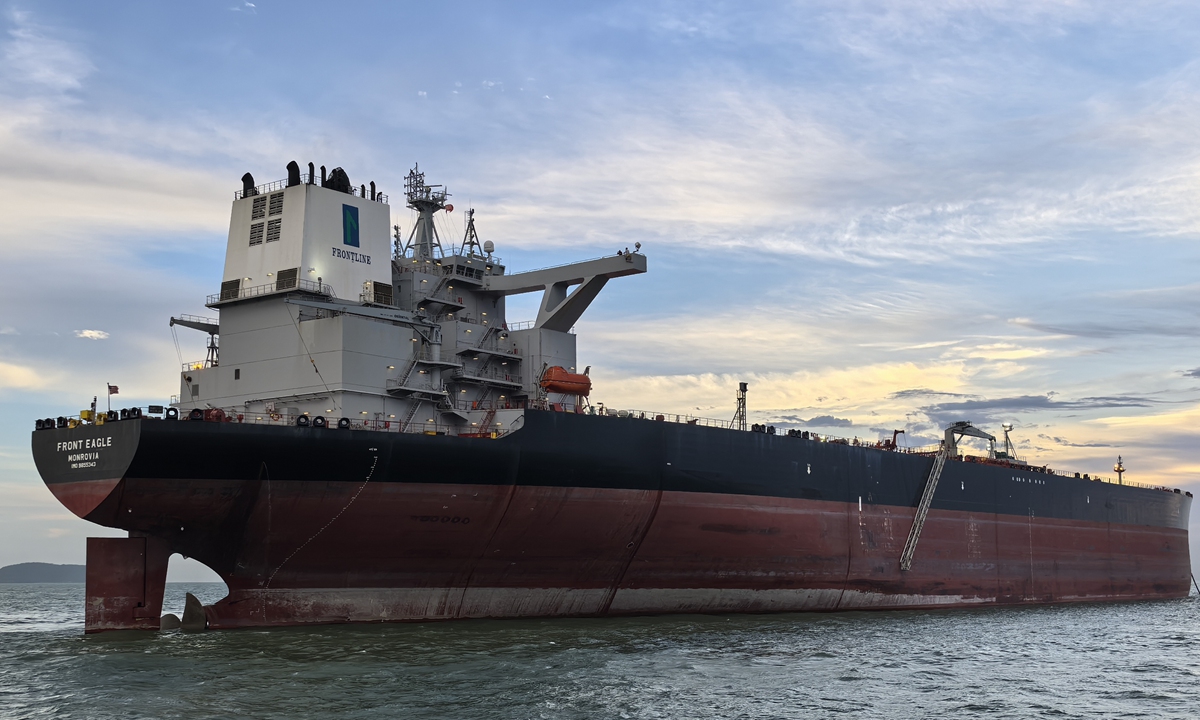
Liberia-flagged vessel Front Eagle Photo: Courtesy of China's Supreme People's Court Guangzhou Maritime Court recently successfully mediated a 180 million yuan ($25 million) dispute arising from a collision between two oil tankers in waters near the Strait of Hormuz, with both parties agreeing to apply Chinese law and submit their dispute to the Chinese court, the Global Times learned from the court on Sunday.
In 2025, two crude oil tankers collided at the eastern entrance to the Strait of Hormuz, 24 nautical miles off Fujairah, United Arab Emirates, media reported.
Owned by oil tanker operator Frontline, the Liberia-flagged vessel
Front Eagle collided with the Antigua and Barbuda-flagged vessel
Adalynn on the morning of June 17, 2025.
The
Adalynn was damaged in the fire. While the
Front Eagle was undergoing repairs in Shenzhen, South China's Guangdong Province, Global Shipping Holding Ltd., which owns the Adalynn, applied to Guangzhou Maritime Court for its arrest. Frontline provided a cash security of 203 million yuan to release the arrest and applied to establish a limitation fund for maritime claims.
The court approved the application and allowed Frontline to establish the limitation fund, setting the amount of the fund at 168 million yuan.
Guangzhou Maritime Court held four pretrial conferences on October 11, 2025, January 12, May 6 and July 13, 2026 to complete preparations for evidence examination, technical investigations and reported the relevant pretrial arrangements to the provincial high court, the Global Times learned from the court.
The court held a public hearing for the case on July 14, 2026.
No government agency had conducted an investigation into the collision, and no official findings were issued after the accident. Taking into account the unique burden-of-proof challenges in maritime collision disputes, Guangzhou Maritime Court took measures to preserve key evidence when handling the vessel arrest, including navigation logs, AIS data, voyage data recorder (VDR) records and CCTV footage, the court told the Global Times in a statement on Sunday.
Under a process that involves exchanging evidence inventories, sealing materials simultaneously and jointly reviewing them after evidence submissions, the court helped ensure the authenticity of critical records and laid the groundwork for determining the facts of the case.
As the two sides and their respective maritime experts reached sharply different conclusions over liability, the court introduced a maritime technical investigator mechanism, with the consent of both parties, allowing technical experts to participate throughout the proceedings. Drawing on the preserved evidence, investigators reconstructed the collision, assessed the vessels' encounter situation and clarified the parties' respective responsibilities.
Following the hearing, the court facilitated mediation, and the two parties reached a settlement agreement on July 27, 2026. On July 31, the court organized the distribution of the maritime liability limitation fund among creditors involved in the foreign vessel collision dispute and related charter-party disputes.
Representatives of the
Adalynn traveled from overseas to the court to present a letter of appreciation and a commemorative banner in recognition of the court's efforts, according to the court statement.
After the Guangzhou Maritime Court accepted the case, both parties agreed to apply Chinese law to establish a maritime liability limitation fund and resolve their substantive dispute, breaking away from the long-standing reliance of international shipping disputes on European and US courts and legal systems.
Choice of justice Bilov Viacheslav, a representative of Global Shipping Holding Ltd., told the Global Times that the main reason they chose a Chinese court to mediate the case is that "we want absolutely fair, unbiased approach to this issue. Because nowadays in this world, there are some countries which believe that they are authorized to give instruction to all others, which definitely is having influence on the decisions of the judge on the approach to the case."
Viacheslav gave the Chinese court's handling of the case a five-star rating, saying he had expected the dispute to take at least three years to resolve, but the Chinese court settled it within just one year. He also praised the judges and lawyers for their commitment to advancing the case throughout the proceedings.
"The judges and lawyers worked to advance the case with the same level of commitment as I did, even though the case directly concerned my own interests. This left a deep impression on me about litigation in China," Viacheslav said.
The case involved two foreign parties and a collision that occurred near the Strait of Hormuz, with no direct connection to China or Guangzhou Maritime Court initially. The fact that the parties chose to seek vessel arrest in China and agreed to apply Chinese law demonstrates the credibility and appeal of China's maritime judicial system, Wu Guining, vice president of the Guangzhou Maritime Court, who served as the presiding judge of the case, told the Global Times.
The court also introduced a maritime technical investigator mechanism in the case, an innovation aimed at addressing complex technical issues arising from vessel collision accidents, Wu said, noting that through technical investigations, the court was able to establish the facts of the case more efficiently, highlighting the integration of professional maritime investigation capabilities with China's specialized maritime adjudication system.
The case demonstrates China's ability to handle major, complex and cross-border maritime disputes with professional expertise, Wu said.
The handling of the collision between the two vessels is just one example of how Chinese courts have been dealing with a growing number of foreign-related maritime cases in recent years.
The Global Times learned from China's Supreme People's Court (SPC) in October last year that over the past 40 years, Chinese courts have handled a total of 88,000 foreign-related maritime cases involving parties from 146 countries and regions.
At a lecture held by the SPC on Friday, Shen Hongyu, director of the Fourth Civil Division of the SPC, told the Global Times that in recent years, Chinese courts have become more influential in participating in and promoting global ocean governance reform. Maritime justice serves as an important instrument for practicing the vision of a maritime community with a shared future and for advancing the reform of the global ocean governance system.
。
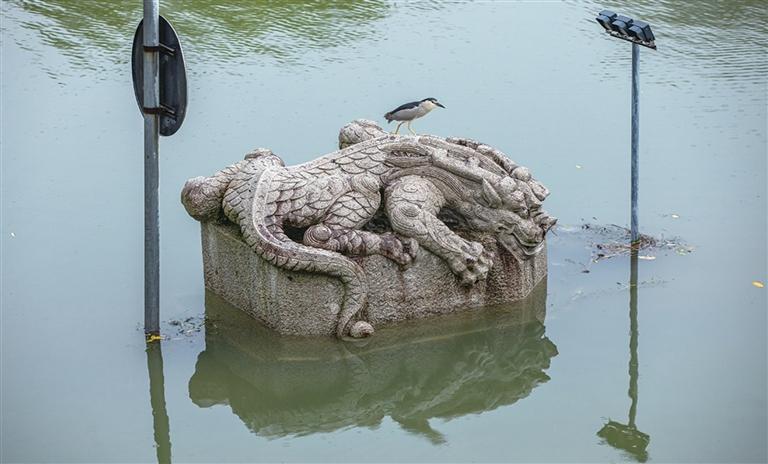
昨天傍晚,一只夜鹭站在趴蝮身上。记者 陈中秋 摄
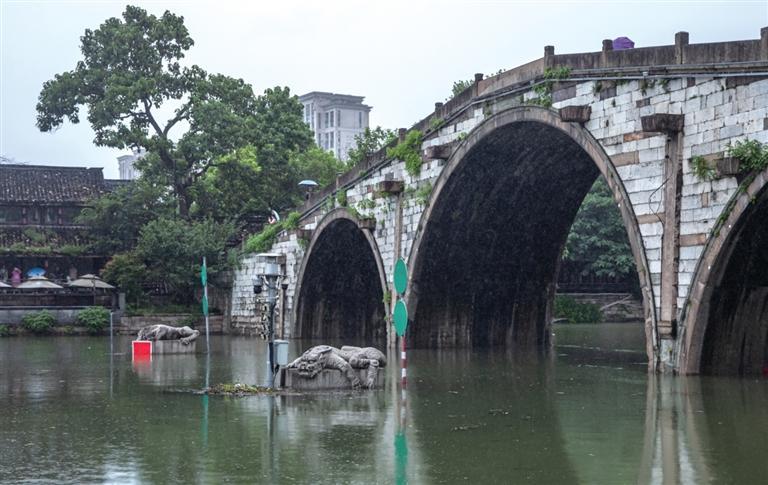
昨天傍晚,镇水神兽趴蝮,运河水已淹过石礅底座。记者 陈中秋 摄台风“白海豚”给杭州带来大风和强降水,前天有网友发帖:路过拱宸桥看到运河涨水,四只神兽快被淹了。昨天上午10点,记者来到拱宸桥。

B | 运河两岸的游步道拉起安全警戒线,地势低的地方被水没过,一家店的员工正往外舀水。桥南桥北,左右各有两只神兽,眼睛注视着水面。河水涨了,水面没过它们的脚和尾巴,远远看去,似乎一低头就能喝到水。到京杭大运河拱宸桥的游客,总要被水中趴卧的四只神兽吸引,拍照打卡。一个小朋友指着神兽问,这是什么?快被水淹了,会不会被冲走呀?孩子妈妈解释,它们是镇水神兽,洪水怕它们,不敢兴风作浪。这不是它们离水面最近的一次。浙江省水利厅8月11日最新发布水文简报:拱宸桥当前水位2.86米,警戒水位2.66米,保证水位3.16米,超保超警幅度0.2米。

C | 2013年10月6日,受台风“菲特”影响,运河水大涨,有人拍到拱宸桥下的趴蝮(又名蚣蝮gōng fù)如一条鳄鱼浮在水面。龙王第六个儿子成镇水神兽拱宸桥下这四只神兽,民间称趴蝮(bā xià),面目威严,兽首獠牙微露,浑身鳞甲虬结,四肢盘曲遒劲,石块刻出饱满的肌肉线条,筋骨隆起,仿佛蛰伏水中的上古异兽,蓄势欲动。明代杨慎《升庵外集》记载:“俗传龙生九子,不成龙,各有所好……六曰蚣蝮,性好水,故立于桥柱。”早在宋元年间,江南运河、古桥桥墩就有人雕刻镇水神兽,用来防撞桥墩、祈求防洪。传说龙生九子,各个不同,有镇水、镇火避雷、钟鼓香火、兵器杀伐……单独去识记,名字就有些复杂,像“赑屃”“蚣蝮”“螭吻”“蒲牢”……老底子杭州人章先生告诉记者,相传很久以前,蚣蝮因为触犯天条,被贬下凡,压在巨大沉重的龟壳下看守运河一千年,千年后终于脱离龟壳,重获自由。千年来趴蝮护河有功,人们为了表彰它,就照着它的模样雕成石像,摆在河边的石墩上,用来镇住河妖,防止洪水侵袭,这就是所谓“趴蝮镇水”。守护拱宸桥21年多次被货船撞到落水这四只趴蝮2005年安装落成。除了“镇水”的寓意,还有美观、防船撞桥、监测水位的实际功能。运河水运繁忙,南来北往的船只过桥屡有撞击剐蹭。

D | 2012年快报热线新闻曾报道:读者杜先生带着儿子在拱宸桥上散步,突然感觉一抖,往下一看,一艘装满石子的货船撞到了桥墩边的一只神兽趴蝮。

E | 还有人拍到趴蝮被撞落水瞬间。2005年以来,趴蝮至少4次被撞落水。2013年有读者拍到,四只神兽只剩一只坚守。趴蝮的每一次被撞,都牵动杭州人的心,媒体多有报道。撞击、落水、打捞、修复、安装……这些神兽存在的意义,不止停留在神话里镇水的虚指,更结结实实保护着拱宸桥这座古桥,试想,两三百吨的运沙船如果直接撞到桥墩,那是多么不堪承受的冲击。自从安装上防撞墩和趴蝮后,拱宸桥被撞的次数少多了,代价是趴蝮几次被撞得歪斜,甚至掉进河里。2009年5月5日,一只趴蝮再次被撞,当天快报记者将情况告知杭州市运河集团,接电话的工作人员听后第一句话是:“啊,又被撞啦!”然后说,马上派人到现场查看。京杭大运河起于北京终于杭州。

F | 拱宸桥是京杭大运河上的最后一座桥,而北京的后门桥是京杭大运河上的第一座桥,后门桥的四角也有四只趴蝮。余光中曾为拱宸桥和趴蝮写诗大运河河水悠悠,发生在桥边的故事也很动人。浙派古琴泰斗高醒华和著名台湾诗人余光中是新中国成立前金陵大学同学,同级不同系,相逢不相识。高老深以为憾,命运齿轮转动,两人在64年后,于2012年在杭州拱宸桥边相聚。高醒华曾作文记录了这次际遇,“那是一个深秋的夜晚,恰逢重阳,拱宸桥边灯火明灭,舒羽咖啡馆里春意盎然。舒羽和诗人们在这里为余光中85岁诞辰举办《登高能赋》庆祝会……”那次聚会后,余光中写了首长诗——《拱宸桥诗会》。咖啡雅座,雕花的亭阁斜对着拱宸大桥,两侧拱起了陡坡,桥墩在中流雄踞着趴蝮,龙生第六遥望若狮,朦胧得惊人桥影在窗格子外,那运河水声滔滔犹似一千多年前……当此情景,拱宸桥、趴蝮在诗人的意象里,变成了文化的符号,是情感的维系,是怀念,是乡愁。
Current article:http://fogushuisanmeinouhun.pics/3sut5c/and1fs.html
Published on:10:54:39
 微信
微信 移动端
移动端


